Project overview
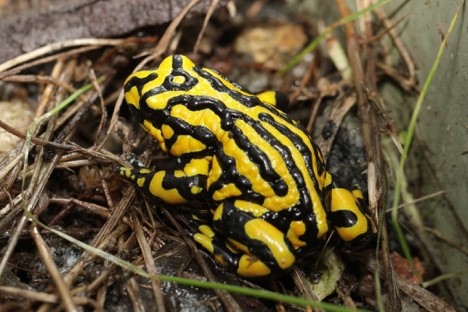
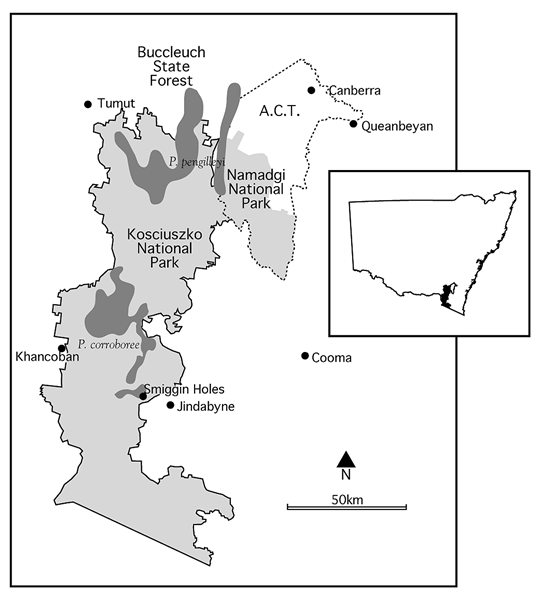
Corroboree frogs are among Australia’s most striking and beloved amphibians. With their bold black and yellow stripes and high-altitude homes in the alpine regions of south-eastern Australia, these tiny frogs once thrived in mountain bogs and wetlands above 2,000 metres. Today, however, both species, the Southern and Northern Corroboree frog, are teetering on the brink of extinction.
The main driver of their decline is a devastating wildlife disease called chytridiomycosis, caused by a microscopic fungus that infects amphibian skin. Since arriving in Australia decades ago, this pathogen has caused catastrophic population crashes across many frog species. Unfortunately, once the fungus becomes established in the environment, it is nearly impossible to remove.
Rather than attempting to eliminate the fungus entirely, researchers are exploring a different question: can frogs be helped to survive alongside it?
A new approach to conservation
Our research program is investigating innovative methods to increase corroboree frogs’ resilience to disease. This work forms part of a conservation strategy known as Targeted Genetic Intervention, which uses genetic knowledge to help threatened species adapt to major challenges such as disease and climate change.
One approach involves selective breeding— pairing frogs that naturally show higher survival when exposed to the fungus so that resistance traits can be passed to future generations. This builds on traditional breeding techniques long used in agriculture and animal husbandry but applied here to wildlife conservation.
A complementary strategy explores whether modern synthetic biology tools could be used to introduce or enhance disease-resistance genes already found in related frog species into Corroboree frogs. While this type of technology is still emerging in conservation, it offers the potential to accelerate adaptation in species that have declined too rapidly to evolve resistance on their own.
Working with communities and partners
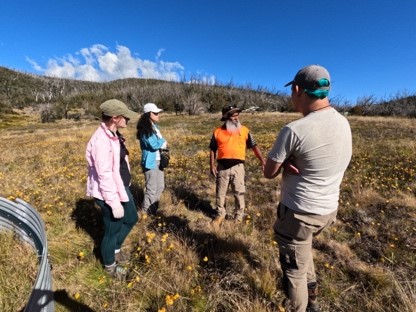
Because these approaches are new and raise important ethical and cultural considerations, community engagement is central to the project. Our research team is working closely with conservation practitioners, the broader Australian public, and Traditional Owner communities to ensure decisions are made transparently and responsibly.
In particular, collaboration with Wiradjuri and Wolgalu community members is helping guide how research is conducted on their Country. Together, we are co-designing field trials, discussing safety and monitoring frameworks, and ensuring that cultural perspectives and priorities shape the future direction of this work.
A hopeful future
While significant challenges remain, advances in medicine, genomics and conservation science are opening new possibilities for species like the corroboree frogs. By combining cutting-edge research with strong partnerships and careful evaluation, this project aims to contribute to a future where these iconic alpine frogs can once again persist in their native environments. The project if successful could be a model for other amphibians and wildlife species facing similar threats to their conservation and help reverse biodiversity loss.
People
- Dr Tiffany Kosch (UoM investigator; tiffany.kosch@unimelb.edu.au)
- Professor Lee Skerratt (UoM investigator; l.skerratt@unimelb.edu.au)
- Associate Professor Lee Berger (UoM investigator; lee.berger@unimelb.edu.au)
- Ms Rose Woodhouse (UoM Msc Science student; rose.woodhouse@student.unimelb.edu.au)
- Dr Kirsty Wissing (ANU investigator, Kirsty.Wissing@anu.edu.au)
Our partners
- Bugang Bila Rangers (NIAA Indigenous Ranger Program for Tumut, Brungle and Snowy Mountains Area, associated with the Brungle-Tumut Aboriginal Land Council)
- NSW-DCCEEW
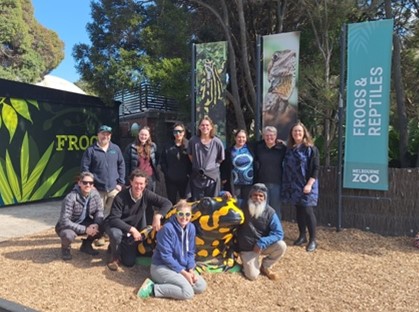
- Zoos Victoria
- Taronga Conservation Society Australia
- Melbourne Biodiversity Institute