Researchers in the Melbourne Veterinary School conduct diverse and varied research in our state-of-the-art facilities.
Our cross-disciplinary veterinary expertise spans parasitology, virology, bioinformatics and animal welfare. We are home to a range of research centres and initiatives dedicated to veterinary excellence, including the Animal Welfare Science Centre and the Asia Pacific Center for Animal Health.
If you are considering graduate research with us, this is your chance to meet our research groups and explore the kinds of projects you could get involved in.
Research by theme
-
Clinical interventions and diagnostics
Our clinical research develops and tests safer, more effective ways to diagnose and treat animal disease, from routine conditions in pets to complex musculoskeletal and metabolic disorders in horses and livestock.
-
One Health
One Health at Melbourne brings together veterinary, medical, environmental and public‑policy expertise to address problems that cross species and ecosystems.
-
Parasitology
Parasitology research at Melbourne investigates the parasites that affect animal health, farm productivity and, in some cases, human wellbeing.
-
Farm systems and productivity
Research on farm systems focuses on producing healthy animals efficiently and sustainably while supporting farmer livelihoods.
-
Animal welfare
Animal welfare research combines behavioural science, physiology and participatory approaches to understand how management, housing and health influence animals’ experiences.
-
Infectious diseases and zoonoses
Our infectious‑disease research seeks to detect, prevent and control diseases that affect animals and can spill over to people.
Research by species
-
Cattle and sheep
Our researchers work across a range of disciplines related to livestock health, management and welfare. In addition to their research, many of them also offer consultancy and other services.
-
Cats, dogs and other pets
Our diverse researchers work across a range of disciplines to conduct world-renowned research, training, professional practice and industry engagement for all kinds of companion animals.
-
Pigs and poultry
From pathology and parasitology to welfare both in Australia and overseas, our researchers work across a range of disciplines to conduct world-renowned research in areas affecting pigs and poultry.
-
Horses
Our researchers work across a range of disciplines to conduct world-renowned research, training, professional practice and industry engagement – including diagnostics, orthopaedics and epidemiology – for both working and athletic horses.
-
Interdisciplinary research
Our diverse researchers work across a range of disciplines in research, training, professional practice and industry engagement. The better we understand the complex interplay between the health of animals, humans and our shared environment, the better outcomes we can achieve for all.
-
Wildlife
Conducting research as varied as epidemiological modelling, climate change and medical implants, our world-renowned researchers work across a range of disciplines to solve global issues affecting many species and ecologies both in Australia and abroad.
Learn more about our research
-
Research partnerships
Partnerships and collaborations play an essential role in our research capability and drive innovation, enrich student learning and empower research impact.
-
Research facilities
We have a range of state-of-the art facilities to address issues in veterinary sciences including the Werribee Equine Centre and the Goulburn Valley Equine Hospital.
-
Research opportunities
Take your research further with graduate research in veterinary science. Find out what kinds of research projects you can join when you study with us.
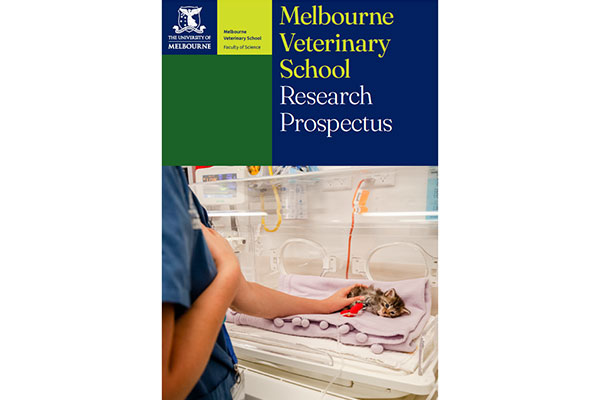
Research prospectus
Our research recognises the complex interplay between human, animal and environmental health. With an interdisciplinary and dynamic approach, our researchers are exploring parasitology, infectious diseases, pathology, biology, and animal welfare. We’re experts in equine disease and home to the University’s Equine Centre, providing specialist care to Australian horses of all shapes and sizes.
Explore our research prospectus to learn more about the depth and breadth of research within the School.
Parasitology image by Vincent C. Duru. Interdisciplinary research image by Tharaka D. Liyanage.