Improving welfare for conservation detection dogs
The Melbourne Veterinary School is pleased to share an interview with Sooyeon Ahn, who recently completed her Honours in Animal Science and Management under the supervision of Dr Mia Cobb in the Animal Welfare Science Centre. Sooyeon was co-supervised by Dr La Toya Jamieson, a wildlife detection dog trainer.
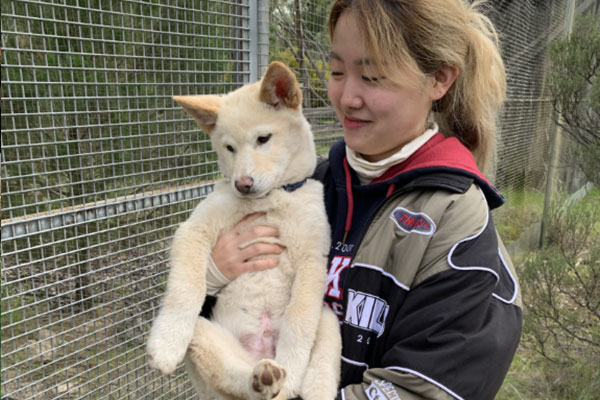
Can you start by telling us a little bit about yourself?
I completed my Honours in Animal Science and Management at the University of Melbourne. I have a strong interest in animal behaviour, conservation and canine science. Through conducting my honours research on the sleep and behaviour of conservation detection dogs, I became even more passionate about understanding how behavioural science can support both the welfare and effectiveness of working dogs involved in threatened species conservation.
What did you research during your honours year?
My honours research examined whether conservation detection dogs (CDDs) sleep or behave differently when housed alone overnight compared to being housed with a familiar dog. Although these dogs play an essential role in threatened species conservation, their welfare – particularly their rest and kennel experience – has been studied far less than their training methods or field performance. Since CDDs spend more than half of every day in kennels after work, understanding their overnight welfare is critical.
Using a six-week within-subjects crossover design, four Zoos Victoria detection dogs alternated between solo and paired housing while their sleep, posture changes and behaviours were recorded each night. Across more than 12,000 observations, the results showed that total sleep time and sleep architecture were almost identical between conditions. Paired housing slightly reduced posture changes, suggesting more stable rest, but it did not noticeably alter behaviour or next-day work performance.
The strongest pattern observed was the presence of large individual differences in sleep patterns and sensitivity to the environment. Overall, the study indicates that cohousing does not harm sleep or welfare, but its benefits vary between individuals. These findings highlight the importance of individual-based kennel management and demonstrate why dedicated welfare research is essential for the wellbeing of conservation working dogs.
What were some of the highlights and challenges of your honours year?
A highlight of this project was working closely with the conservation dog team at Zoos Victoria and developing advanced behavioural coding and statistical analysis skills. It was incredibly rewarding to contribute to welfare-focused applied research with practical implications for working dog management.
The challenges included handling large and complex datasets, managing missing environmental recordings, and remaining adaptable when early hypotheses were not supported by the data. These experiences strengthened both my technical skills and my resilience as a developing researcher.