Testing new ways to detect mange in wild wombats
The Melbourne Veterinary School is pleased to share an interview with Grace Holland, who recently completed her Honours in Veterinary Bioscience under the co-supervision of Associate Professor Jasmin Hufschmid and Professor Lee Skerratt in the One Health Research Group.
Can you start by telling us a little bit about yourself?
I’m a recent graduate of the Bachelor of Science (Honours) at the University of Melbourne. My honours research investigated the reliability of existing scoring systems used to detect sarcoptic mange in free-ranging wombats (Vombatus ursinus).
I first became involved in this area through volunteering at a wildlife shelter in the Dandenong Ranges, where I have spent the past three years working alongside dedicated carers and researchers. Through these connections, I found myself drawn into the fascinating world of wildlife research, mange and wombats.
I have always been passionate about conservation, with a particular interest in Australian native wildlife. I’m excited to see where a career in wildlife conservation takes me, and to contribute to protecting unique and precious landscapes and the animals that inhabit them – especially as they face growing threats from disease, habitat degradation and a changing climate.
What did you research during your honours year?
I set out to assess the precision of current scoring systems used to detect sarcoptic mange in wombats and to identify ways to improve their usability and reliability. I investigated differences in precision between field observations and image-based assessments, with volunteers of varying experience levels using these systems in both contexts.
Adapting methods from burn assessment in humans – and, more recently, koalas – we incorporated body surface area measurements into scoring systems to more accurately capture the extent of mange when using visual diagnostic tools. Combined with results from a usability survey, this research provided the foundation for developing two refined scoring systems: one focused on research applications and another designed to be more accessible for members of the public involved in volunteer treatment programs.
While we were not able to test these refined systems within the timeframe of my honours year, this research demonstrates clear opportunities for improving visual detection of sarcoptic mange – a disease that remains prevalent in bare-nosed wombat populations throughout south-eastern Australia.
What were some of the highlights and challenges of your honours year?
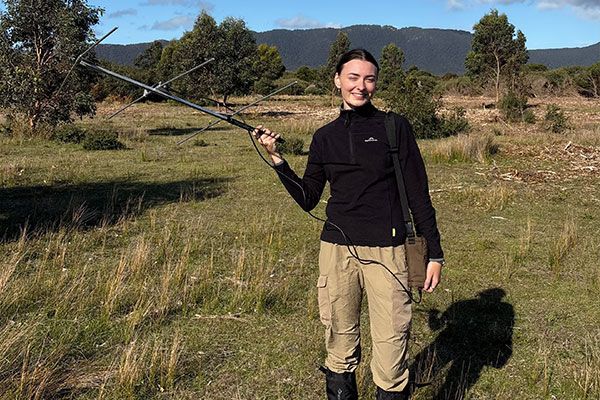
Getting to participate in fieldwork for a concurrent mange study – as well as running a few of my own field trips down to Wilsons Promontory National Park – was by far a highlight of my honours year. The biggest challenge was trying to fit this research into a relatively short timeframe, while balancing logistics, data collection, analysis and writing. Coordinating everything at this scale was completely new territory for me, but it was incredibly valuable experience.
Discover research opportunities in the Melbourne Veterinary School