Improving welfare for animals in our care
The Melbourne Veterinary School is pleased to share an interview with Dr Megan Lucas, a lecturer in animal welfare within the Animal Welfare Science Centre. Megan was recently awarded a Dean’s Excellence Award in Education – Small Class Teaching for innovative curriculum leadership and teaching that enriches student learning, including the development of the world’s first virtual herd of pigs. Megan was also a finalist in the 2025 Big Science Pitch.
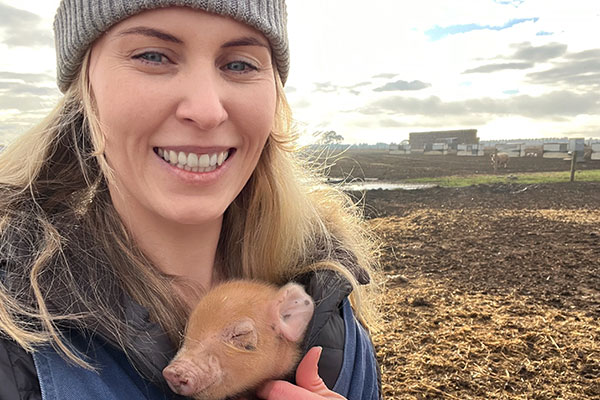
Can you tell us a bit about your background and how you ended up at the University of Melbourne?
I started an undergraduate degree at the University of Melbourne in 2010 and never left! I completed a Bachelor of Science majoring in Animal Science and Management and discovered my passion for animal behaviour and welfare in my third year. At this time, I was most interested in companion animals and pursued an Honours year through the Animal Welfare Science Centre within the Melbourne Veterinary School (MVS), researching ways to measure the human-dog relationship.
The natural progression was a PhD, but I changed species and researched the impact of humans and early-life experiences on stress in farmed pigs, still under the supervision of researchers at the Animal Welfare Science Centre. A postdoc on abnormal behaviour in pigs with the same team followed, and my current role is as a lecturer in animal welfare in MVS – coordinating the subjects that originally inspired my passion for this discipline.
What topics do you cover in research and teaching at the University?
While my research expertise is in pigs, my teaching spans across species. I cover the behaviour and welfare of any animals under human care – including those in homes, zoos and on farms. My goal as an educator is to inspire the next generation of animal welfare scientists.
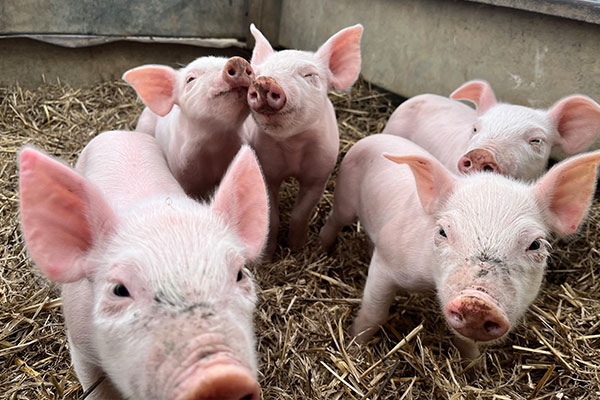
Alongside my teaching responsibilities, I am developing a portfolio of applied animal welfare research that focuses on improving housing and management practices for farmed pigs. Much of the research we undertake at the Animal Welfare Science Centre is highly applied, meaning we work closely with farmers and other industry partners. For example, our pig welfare research is typically carried out under commercial conditions on pig farms.
Conducting research under commercial conditions can be challenging, as it needs to fit alongside routine farm operations, but it ensures our work has real-world relevance and impact, often through the direct translation of outcomes.
What does a day in the life look like for your job?
One of the things I value most about this career is that there are no typical days. On Monday I might be in the classroom lecturing on social behaviour in chickens, and on Tuesday I can be knee-deep in a wallow on a free-range pig farm.
Can you give us some insight into your life outside of work?
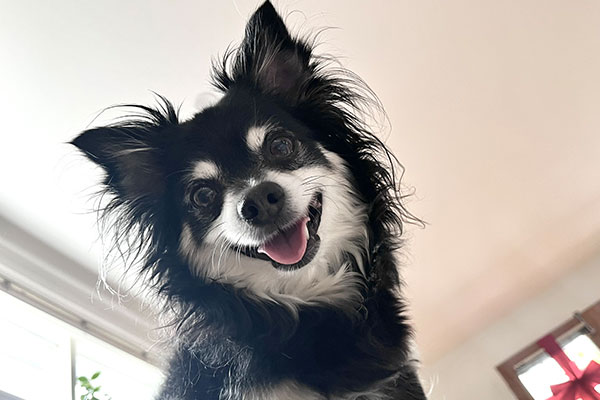
I am owned by a senior rescue Chihuahua mix named Nacho. After adopting Nacho in the third year of my undergraduate degree, I thought I had lovingly given a home to a small, quiet and low-maintenance dog – but only one of these characteristics turned out to be true.
Soon after bringing him home, a range of behaviour ‘issues’ emerged, including separation anxiety, reactivity and fearfulness. Working through these challenges, alongside studying animal behaviour and welfare in my final year, sparked my interest in how behaviour develops, what maintains it, and why it is such a core component of every animal’s welfare.
I probably wouldn’t have ended up in this career had it not been for a little Chihuahua mutt that needed rehabilitating!
Learn more about Megan’s work:
Discover research opportunities in the Melbourne Veterinary School